
FoScenes
Zhou, C., Yin, T., Wei, S., Cook, B. D., Tan, W., Yan, W. Y., … & Gastellu-Etchegorry, J. P. (2026). FoScenes: A high-fidelity, large-scale 3D forest plant area density product derived from open-access airborne lidar data. Remote Sensing of Environment, 333, 115150.
Data Portal: https://foscenes.3msi.net/
Access paper: https://doi.org/10.1016/j.rse.2025.115150
The preliminary version of FoScenes releases 40 seamless scenes over 28 diverse sites, with individual area ranging from 50 to about 11,000 hectares, using ALS data acquired by NASA Goddard’s LiDAR, Hyperspectral & Thermal Imager (G-LiHT).
Updates
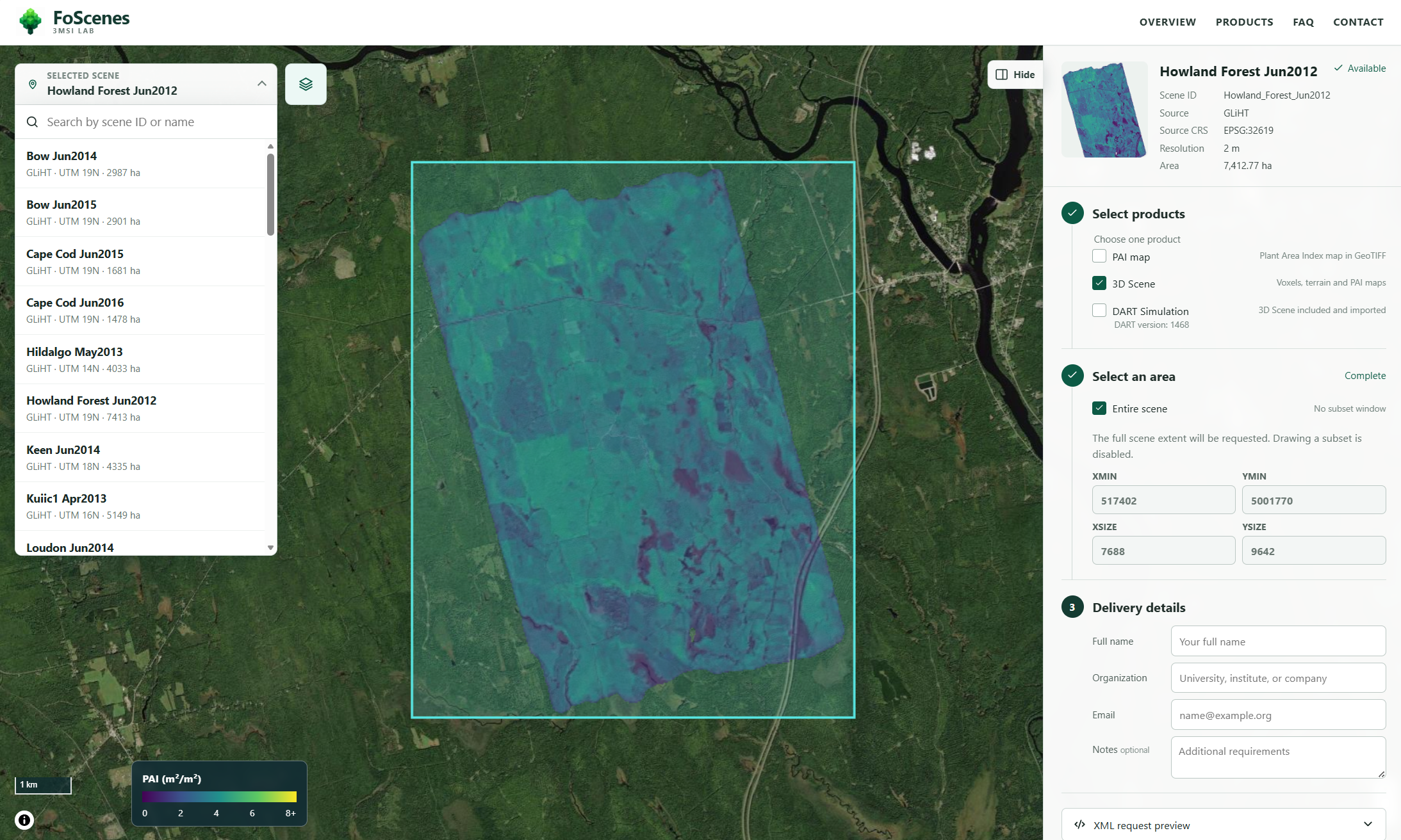
[News] The data access portal is now online. Download 3D scenes and DART simulation by interactive webpage.
[v2.2] 2026-05-21 Fix inconsistency in delimiter, now ‘space’ for all data.
[v2.1] 2026-01-10 Fix inconsistency between sites and data files.
[v2.0 ] 2026-01-10
-
Add Incompletely Explored voxels to scenes for more accurate representation, without affecting PAI.
-
vox_pad.txtis now the only released vox PAD file (previously namedvox_pad_coord.txtorreal_vox_pad_coord.txt). -
dtm_dart.txtandvox_pad_ind.txtare no longer included in the data release. These files can be generated via the updatedclip.py(see the following Use FoScenes in DART section).
[v1.0] 2025-01-08 Initial release
Download
-
Data Access Portal: https://foscenes.3msi.net/
-
Tools and DART-DAO: Google drive
The list of sites is provided in paper Table of sites.
Data Description
1. 3D Space
The 3D voxel space is defined by the projection system, minimum borders, and spatial extents.
proj.txt: Well-known text (WKT) string of the projection system.bord_size.txt:
[Min_UTM_X, Min_UTM_Y, Elev_Lowest, Size_Of_X, Size_Of_Y, Size_Of_Z]
All values are in meters. Elevation is referenced to the EGM96 geoid.
2. Voxel Plant Area Density (PAD) Files
Each row records either the voxel center coordinates or the voxel indices in the 3D voxelized space, together with its PAD value.
vox_pad.txt: [x, y, z, PAD]vox_pad_ind.txt: [i, j, k, PAD]vox_pad_coord.txt: [x, y, z, PAD]
3. Digital Terrain Model (DTM)
The terrain point cloud is generated from a 1-m resolution DTM grid, provided in either the UTM coordinate system or the DART image coordinate system.
dtm_cloud.txt: [x, y, z]dtm_dart.txt: [col, row, z]
4. Plant Area Index (PAI) Map
-
GeoTIFF files: Plant Area Index (PAI) maps derived by vertical integration of PAD, primarily used for quality control.
- Vegetated pixels: LAI > 0
- Non-vegetated pixels: LAI = 0
- Insufficient LiDAR sampling: LAI = −1
Citation
@article{zhou2026foscenes,
  title   = {FoScenes: A high-fidelity, large-scale 3D forest plant area density product derived from open-access airborne lidar data},
  journal = {Remote Sensing of Environment},
  volume  = {333},
  pages   = {115150},
  year    = {2026},
  issn    = {0034-4257},
  doi     = {10.1016/j.rse.2025.115150}
}
Contact & Collaboration
We welcome collaborations in various forms. If you have your own lidar data and are interested in forest structure reconstruction on your sites, please feel free to reach out.
For general inquiries regarding FoScenes, please contact
Cailin: cailinzhou.polyu@gmail.com
For collaboration opportunities and further details, please contact
Tiangang: tiangang.yin@polyu.edu.hk